Project Hail Mary
What is a person, if not their memories?

The title Project Hail Mary is itself a contradiction of faith and desperation. A “Hail Mary” is both a Catholic prayer and a sports term for a final impossible attempt — a surrender to hope when logic has already failed. Humanity, standing at the edge of extinction beneath the dimming Petrova line, turns to Grace as its final prayer. Not because he is willing. Not because he is heroic. But because there is no one else left.
Grace becomes humanity’s sacrifice long before he becomes its saviour.
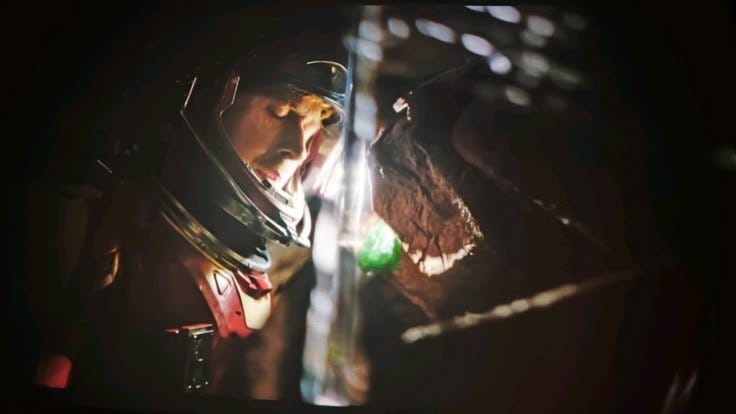
The cruel irony of his name is impossible to ignore. Grace implies mercy, forgiveness, divinity — something freely given. Yet throughout the film, grace is the one thing humanity never offers him. The compassion he is denied by mankind is instead given to him by something entirely alien: Rocky. Not another human. Not the governments he serves. Not the species he ultimately saves. But a creature evolutionarily incapable of understanding human emotion, who somehow embodies humanity more truthfully than humanity itself.
The film repeatedly frames existence through the language of predator and prey. The Petrova line consumes stars. Entire solar systems are slowly hunted into extinction. Nature itself becomes a cycle of consumption, survival, and fear. Yet Grace remains blind to his own position within that hierarchy. He studies predators while failing to recognise himself as prey.
The fox sweater he wears throughout the film becomes devastatingly symbolic in retrospect. At first glance it appears harmless, almost comforting — a remnant of his life as a teacher, a reflection of warmth and familiarity. But the fox is both predator and hunted animal. Clever enough to survive, yet still trapped inside a larger food chain. The sweater quietly foreshadows what Grace refuses to admit: that the institutions governing him never truly saw him as a man. Only as a statistical probability. A necessary body. A test subject sent into the void because the continuation of the species outweighed the sanctity of individual life.

Humanity survives by convincing itself sacrifice is noble when it is distant enough.
Only when Grace regains his memories does the illusion finally collapse. The horror is not simply that he was sent into space. It is that he was taken. Dragged unconscious across the floor like cargo. Stripped not only of choice, but of dignity. The final image burned into his memory is not one of patriotism or triumph, but the feet of someone he trusted standing over him as he is carried away from Earth forever.
That scene redefines the entire film.

Until then, the audience is encouraged to believe Grace’s amnesia protects him from fear. But memory is not merely recollection — it is identity itself. Once his memories return, he becomes fully human again, because suffering returns with them. Terror returns with them. Consent returns with them.
And suddenly his refusal no longer appears cowardly.
It appears profoundly human.
Cinema often glorifies self-sacrifice to the point of cruelty, treating survival instinct as moral weakness. But Project Hail Mary refuses that simplification. Grace does not want to die because he loves life. He loves his students. He loves the ordinary intimacy of existence. His desperation is not ego — it is attachment.
“Dr Grace i don’t have the luxury of leaving samples here just to stroke your bruised ego”
“ego? this isn’t about my ego! it’s about my children!”
“you don’t have children”
“yes i do! dozens of them!”
The tragedy of that line is that the children are not biologically his. Yet emotionally, spiritually, they are. Grace’s classroom represents the one place in his life where he existed without performance or expectation. In teaching, he was not useful because he could save humanity. He was valuable simply because he cared.
And perhaps that is the film’s central question:
What gives a life meaning? Utility — or connection?
Eva Stratt emerges as one of the most morally fascinating characters precisely because the film refuses to make her comfortably villainous. She is terrifying not because she lacks reason, but because she possesses too much of it. A historian by discipline, Eva understands humanity through patterns rather than ideals. She knows civilizations survive through sacrifice, coercion, and impossible decisions. History has taught her that morality bends under extinction.
“Life is reason.”
To Eva, emotion becomes dangerous because emotion hesitates. Logic acts. Logic preserves the species. Yet beneath her coldness is exhaustion — almost spiritual exhaustion. Her brief mention of God reveals this fracture perfectly:
“God willing”
“you believe in god?”
“it beats the alternative”
It is not faith. It is desperation masquerading as faith. A woman so burdened by the inevitability of history that she reaches for anything capable of interrupting it.
And this is where the parallel between Eva and Eve becomes hauntingly brilliant.
Like Eve, Eva becomes associated with humanity’s “fall” — blamed for the catastrophic choice that alters the fate of mankind forever. Yet history repeatedly condemns women more harshly for decisions men quietly benefit from. Eva bears the emotional weight of humanity’s survival while the men around her retain the luxury of moral distance. She becomes the necessary monster history always creates during moments of collapse.
But what makes Project Hail Mary extraordinary is that it ultimately rejects cynicism.
Despite betrayal, fear, exploitation, and grief, the film insists that hope survives through honesty and connection. Rocky and Grace transcend biology, language, and planetary difference not because they are identical, but because they choose trust. In a universe governed by consumption and survival, kindness becomes revolutionary.
The most beautiful aspect of the film is not humanity saving itself.
It is humanity rediscovering itself through something non-human.
Grace begins the story believing survival is the highest goal. But by the end, survival alone is meaningless without companionship, memory, and love. His relationship with Rocky becomes proof that empathy is not an evolutionary advantage — it is something far more sacred. It is the one force capable of interrupting the endless predator-prey cycle history keeps repeating.
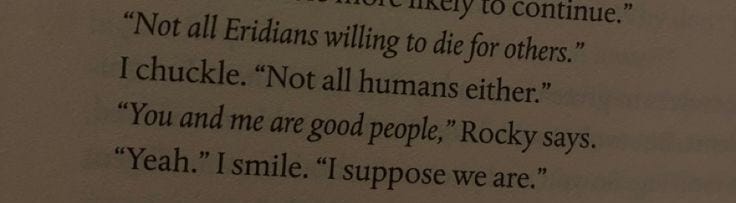
And perhaps that is why the film lingers so painfully on memory.
Because memories are not simply records of who we were.
They are evidence that we were loved, feared, needed, wounded, forgiven.
Without memory, Grace survives.
But only through remembering does he become a person again, statement.